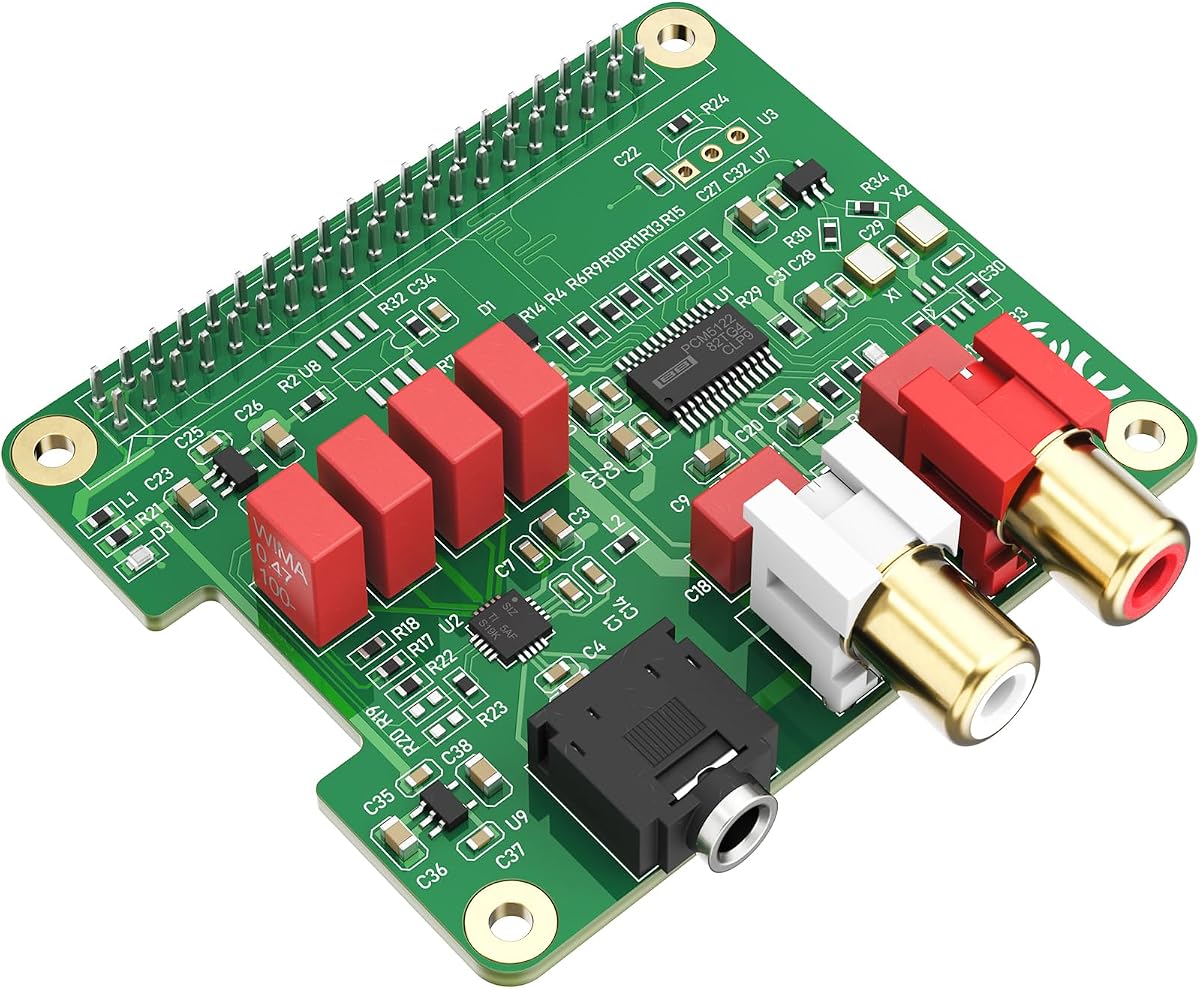
HiFi DAC HAT for Raspberry Pi 5/4/3B+/Zero
4.5Editor score
PCM5122 384kHz/32bit DAC
Dual ultra-low jitter oscillators
Gold-plated RCA and 3.5mm outputs
This guide compares the top DAC for Raspberry Pi models including HiFi DAC HATs, digital converters, and audio shields for high-resolution music streaming.
Finding the right DAC for Raspberry Pi transforms your mini computer into a serious audio player. These expansion boards bypass the weak onboard sound, delivering crisp high-resolution playback directly through analog or digital outputs.
We evaluated ten leading DAC options based on audio chip quality, software compatibility, and build design. Each entry offers unique strengths whether you need balanced outputs, digital isolation, or compact form factors for specific projects.
Every pick shows detailed specs pros and cons to help you match the board to your needs. Prices and availability change frequently so check current listings before purchasing your next audio upgrade today.
4.5Editor score

4.5Editor score

4.1Editor score
This side-by-side comparison highlights key specifications across all ten selected DAC boards so you can quickly identify the best fit for your audio project needs.


This board stands out as the Editor's Choice due to its balance of performance and ease of use. It integrates seamlessly with Pi models through the GPIO header delivering 112dB SNR audio quality.
We may earn a commission when you buy through this link, at no additional cost to you.
The dual ultra-low jitter oscillators ensure accurate timing which is critical for high resolution playback. Its compatibility with Volumio Moode and LibreELEC makes setup straightforward for any user.
While it lacks balanced XLR outputs which some audiophiles prefer the single ended performance is excellent. The lack of a dedicated power supply requirement can be a trade off for cleaner signal paths.
Anyone seeking a reliable high fidelity upgrade for their Pi should consider this board first. It offers professional features at a fraction of the cost of standalone audio gear.
The TI PCM5122 chip provides 112dB SNR and low THD+N ensuring pristine sound reproduction for critical listening environments.
Tested with major media center software including Volumio and RuneAudio allowing flexible integration into existing home setups.
We may earn a commission when you buy through this link, at no additional cost to you.
Designed specifically for compact Pi boards this DAC offers a perfect fit for Zero users without overhanging. It delivers audiophile grade sound that challenges more expensive options in its price bracket.
We may earn a commission when you buy through this link, at no additional cost to you.
The PCM5122 paired with the TPA6133 amplifier drives headphones cleanly with 2.1Vrms output. Software compatibility extends to PiCorePlayer and Max2Play ensuring versatility across various media systems.
Though it lacks the dual oscillators found in higher end models the timing accuracy remains solid for standard listening. Its compact design might limit airflow in some enclosed cases.
This is the ideal choice for builders using small Pi units who need quality sound without cluttering the workspace. It brings high fidelity audio to budget constrained projects effortlessly.
Specifically shaped to fit Pi Zero models perfectly maintaining full 40 pin compatibility for standard Pi 4 and Pi 5 boards.
The DAC and amplifier combination ensures powerful clean signal output even when driving higher impedance headphones directly.
We may earn a commission when you buy through this link, at no additional cost to you.
This premium board features the flagship ESS ES9038Q2M chip delivering unparalleled 129dB DNR and true DSD512 support. It is engineered for users who demand absolute bit-perfect studio quality sound from their Pi.
We may earn a commission when you buy through this link, at no additional cost to you.
Independent ultra-low jitter clocks eliminate timing errors ensuring precise sample rates. The balanced XLR style outputs allow connection to professional audio gear without interference from ground loops.
While it is more expensive than standard options the sound quality justifies the investment for serious audiophiles. Initial configuration may require more attention to detail compared to plug and play boards.
Buy this if you need maximum fidelity and balanced connectivity for high-end systems. It represents the pinnacle of Pi-based audio conversion technology available today.
The ES9038Q2M converter delivers high resolution 32bit/384kHz PCM and DSD512 for true studio quality sound reproduction.
Three TI op-amps drive robust balanced X+ and X- outputs ideal for connecting to high end amplifiers and studio monitors.
We may earn a commission when you buy through this link, at no additional cost to you.
This Hat is unique as a digital converter rather than an analog DAC offering optical TOSLINK and coaxial RCA outputs. It is designed to offload processing to an external high quality amplifier system.
We may earn a commission when you buy through this link, at no additional cost to you.
Galvanic isolation ensures complete separation of digital signals and power noise from the Pi significantly improving signal quality. The I2S master mode and dual oscillators provide accurate audio clocking.
It does not have built-in analog outputs so you must have a separate DAC to listen. However for users wanting isolation and digital flexibility it is a top choice.
Choose this board if you plan to connect to high-end external DAC systems. It ensures the cleanest possible digital signal transmission from your Pi.
Digital isolators and power isolators ensure better output signal quality by separating power and signals from the main system.
Supports OSMC Max2Play and Volumio systems making it flexible for different audio distribution networks and players.
We may earn a commission when you buy through this link, at no additional cost to you.
This module offers a high-quality DAC experience at a very accessible price point. It features the PCM5122 chip with an I2S interface and provides clear LED status indicators for monitoring performance.
We may earn a commission when you buy through this link, at no additional cost to you.
The board supports 384KHz sampling and 112dB dynamic range delivering impressive sound clarity. It connects easily to external amplifiers and allows for infrared receiver integration via GPIO26.
While it lacks the elaborate build of premium boards it delivers core functionality effectively. Users should note the basic design might require additional housing for stable mounting in projects.
It is an excellent choice for DIY enthusiasts starting with HiFi projects. The performance-to-cost ratio makes it a standout option for beginners.
LED indicators show DAC power and working status providing immediate visual feedback on system performance.
With a 112dB dynamic range and 16-32 bit resolution this module offers rich detailed audio playback for various formats.
We may earn a commission when you buy through this link, at no additional cost to you.
The V3 Hat features an EEPROM chip that enables true plug and play functionality without driver installation. It delivers exceptional 112 dB SNR with a clean 32-bit 384kHz sampling rate.
We may earn a commission when you buy through this link, at no additional cost to you.
The design is visually appealing with a colored PCB suitable for visible projects. It works with Pi 5 and Zero v2 ensuring broad support across different hardware generations.
While installation is easy finding specific detailed configuration documentation can be challenging compared to larger brands. The headphone amp is decent but not as powerful as dedicated amps.
This board is perfect for users who want simplicity and quick setup. It removes technical barriers to enjoying high-quality audio on a Raspberry Pi.
New EEPROM chip allows for plug and play setup requiring no manual driver configuration or installation steps.
Compatible with Pi 5 4 Zero and older models ensuring longevity and flexibility for various hardware projects.
We may earn a commission when you buy through this link, at no additional cost to you.
This dedicated board is optimized for the Raspberry Pi 5 featuring a ground loop isolator to reduce hum noise. It is praised by users for delivering clean high-quality audio performance.
We may earn a commission when you buy through this link, at no additional cost to you.
The included isolator prevents unwanted transmission of noise ensuring a clearer signal path to headphones or amplifiers. Setup is straightforward with easy installation through the 3.5mm audio port.
Its scope is limited to Pi 5 models which reduces versatility for multi-project households. The output options are basic so it may not suit complex audio setups.
Choose this if you prioritize noise reduction on a Pi 5 setup. It solves common audio hum issues effectively for hobbyists and professionals.
Includes a ground loop isolator that helps prevent the transmission of unwanted noise or hum in the audio output.
Designed for easy installation with plug and play functionality allowing immediate audio out via 3.5mm port.
We may earn a commission when you buy through this link, at no additional cost to you.
This board acts like a DAC on steroids with a 300 MHz DSP that can run thousands of instructions per sample. It allows for room equalization and dynamic DSP parameter changes.
We may earn a commission when you buy through this link, at no additional cost to you.
It supports standalone boot without the Pi thanks to onboard EEPROM making it versatile for standalone DAC setups. The asynchronous sample rate converter manages audio quality efficiently.
Configuration requires technical knowledge and a specific CaseIII enclosure limiting ease of use for beginners. It is more expensive but offers unmatched flexibility for custom audio tuning.
Ideal for advanced users needing precise audio control and equalization. It provides professional-grade processing in a compact board format.
Features 300 MHz DSP allowing real-time parameter changes and room equalization for tailored audio experiences.
Onboard EEPROM allows the board to boot and run even without a connected Raspberry Pi for standalone use cases.
We may earn a commission when you buy through this link, at no additional cost to you.
This digital sound card provides Toslink and Coaxial outputs for connecting to external audio systems. It ensures bit-perfect audio streams without modification making it reliable for audiophiles.
We may earn a commission when you buy through this link, at no additional cost to you.
The dedicated S/PDIF interface supports up to 192kHz/24bit resolution ensuring high fidelity data transmission. It is designed for Pi 2 models but remains a solid choice for legacy systems.
It lacks analog outputs so external amplification is required. While older in design its performance remains top-tier for digital connectivity and sound quality.
Select this for reliable digital connection to high-end audio systems. It offers a robust solution for legacy Pi hardware integration.
Audio data streams are not modified in any way ensuring bit-perfect output for pure audio reproduction.
Features both Toslink optical and coaxial electrical connectors providing flexibility for various amplifier inputs.
We may earn a commission when you buy through this link, at no additional cost to you.
This module is an incredibly affordable solution offering high-quality digital audio conversion. It uses the PCM5102A chip with I2S interface providing better sound than standard onboard audio.
We may earn a commission when you buy through this link, at no additional cost to you.
The stereo jack comes soldered onto the board simplifying the build process. It serves as a lossless decoder suitable for voice modules and simple projects requiring clear playback.
It is less refined than dedicated HATs but functions reliably for basic tasks. The lack of a case or complex features makes it strictly a DIY component rather than a finished product.
Best for beginners or projects needing low-cost audio output. It provides clear digital conversion without requiring additional hardware or expertise.
Provides a super affordable high-quality DAC solution that sounds much better than the onboard analog audio options.
Stereo jack comes soldered onto the board already saving time and effort on assembly for projects.
We may earn a commission when you buy through this link, at no additional cost to you.
Selecting the right DAC board involves understanding chip capabilities output types and software support. This guide covers the essential factors to consider before making a purchase.
The core of any DAC is the chip used for digital to analog conversion. High-end chips like the ESS ES9038Q2M offer higher SNR and lower distortion than budget options like PCM5102. Look for DACs that support your desired resolution such as 32bit/384kHz for high fidelity playback.
Prioritize chips known for low jitter and high dynamic range to ensure sound clarity.
Decide if you need analog outputs like RCA or 3.5mm jacks or digital outputs like Toslink and Coaxial. Analog boards connect directly to amplifiers while digital boards route signals to external DAC units for higher quality processing.
Ensure the board supports the connectors your current audio equipment uses to avoid extra adapters.
Check that the DAC works seamlessly with media players like Volumio Moode or OS systems. Universal support ensures easy configuration without manual driver installation or complex setup routines.
Look for boards with EEPROM chips for plug and play functionality across different systems.
Independent oscillators on the board reduce timing jitter which improves audio quality. Boards with dual oscillators offer better precision than those relying on the Pi's internal clock.
Higher quality clocking systems result in more accurate sample rates and clearer sound reproduction.
Consider the dimensions of the DAC especially if you are using compact Pi Zero models. Standard HATs may overhang on smaller boards so check the product details for compatibility with your hardware.
Choose boards designed for compact fit to avoid interference with cooling fans or enclosures.
Some advanced boards include DSP capabilities for equalization or sample rate conversion. These are useful for custom audio tuning but may require more technical knowledge to configure effectively.
Select boards with DSP only if you need specific audio processing or standalone operation features.
Look for gold plated connectors and proper shielding to prevent electromagnetic interference. Galvanic isolation on digital boards protects against ground loops and noise transfer from the Pi.
Solid build quality ensures durability and reduces the risk of signal degradation over time.
Comprehensive wikis and community support simplify setup and troubleshooting. Check if the manufacturer provides clear guides for OS integration and configuration.
Strong documentation helps you get the most out of the hardware without frustration.
Install the DAC board on the GPIO header ensuring it aligns perfectly. Secure it with screws if your case allows and verify that no pins are bent or obstructing components.
Update your Raspberry Pi OS and install necessary media player software like Volumio or Moode. Configure the audio output settings within the OS to recognize the external DAC automatically.
Regularly check for firmware updates and clean the board with compressed air to prevent dust buildup. Proper ventilation maintains cooling performance and extends the lifespan of your audio hardware.
Yes but you must choose a compact board that fits without overhanging. Many models have versions designed specifically for the Zero series while standard HATs may be too large. Check dimensions before buying.
Most modern DAC boards feature EEPROM chips that make them plug and play without drivers. Simply connect the board and update your media player settings to use the new audio output automatically.
Analog DACs output sound directly through RCA or headphone jacks for immediate playback. Digital DACs send audio signals via Toslink or coaxial to external amplifiers for higher quality processing and isolation.
Models with PCM5122 or ES9038Q2M chips typically support 32bit/384kHz and DSD formats. Always check the specs for max resolution support to ensure compatibility with your music library.
Independent clocks reduce jitter ensuring precise timing for audio samples. This results in clearer sound and better separation compared to boards that rely on the Pi's internal timing system.
It helps eliminate hum and noise caused by electrical interference between devices. If you experience buzzing sounds connecting a ground loop isolator can significantly improve audio quality.
Some boards with onboard EEPROM allow standalone boot without the Pi. However most require the Pi for media processing and software control unless they have specific standalone DSP features.
The HiFi DAC HAT stands out as the Editor's Choice for balancing performance and value while the DAC Mini Hat offers great budget-friendly options for compact boards.
Prioritize boards with independent oscillators and high SNR if audio clarity is your main goal. Check compatibility with your specific Pi model and OS to ensure smooth integration.
Prices and availability change often so verify current listings before finalizing your purchase. Investing in a quality DAC transforms your Pi into a high-fidelity music player easily.