
ELEGOO 0.96 Inch OLED Display Screen Module
4.6Editor score
Self-luminous pixels
128×64 graphics
Includes jumper wires
This guide compares the top Arduino LCD Display modules for 2026 including OLED and TFT options to help makers choose the right screen for their projects.
Selecting the right Arduino LCD Display can transform a simple microcontroller project into a polished product with clear visual feedback. Whether you need basic text output or vibrant graphics, the market offers diverse options ranging from classic character screens to modern OLED and TFT panels. Understanding the specific needs of your build helps narrow down the choices significantly.
We evaluated ten highly rated display modules based on resolution, interface type, compatibility, and user feedback. Our analysis focuses on practical aspects like wiring simplicity, power consumption, and library support to ensure you can integrate these screens without frustration. Each product was reviewed for its unique strengths and potential limitations in real-world scenarios.
Every pick in this list highlights key features, pros, and cons to guide your decision-making process effectively. While we provide detailed insights based on current market data, please note that pricing and availability can change frequently. Always verify the latest details on the product page before finalizing your purchase to ensure the best value.
4.6Editor score

4.5Editor score

4.6Editor score
This side-by-side comparison highlights the core specifications and unique attributes of each selected display module to help you quickly identify the best fit for your specific Arduino project requirements.




The Hosyond 1602 LCD module offers a reliable solution for displaying text on Arduino projects. With a 4.5 star rating, it is praised for its ease of use and clear blue backlight. This module simplifies wiring by using an I2C interface instead of parallel connections.
We may earn a commission when you buy through this link, at no additional cost to you.
Its standout quality is the built-in potentiometer that allows you to adjust the backlight intensity easily. The module is compatible with a wide range of boards including Arduino and Raspberry Pi. This versatility makes it suitable for various IoT and DIY applications.
While it only supports two lines of sixteen characters, this is sufficient for most basic data displays. The I2C interface requires minimal pins which is a significant advantage. However, it is not ideal for graphics or complex visual elements.
This product is perfect for beginners and experienced makers needing a dependable text display. Its multi-pack nature ensures you have spares for future projects. We recommend this for anyone needing a standard character screen.
The I2C protocol reduces the number of GPIO pins required allowing more room for sensors and other components.
The onboard potentiometer lets you fine-tune the contrast ensuring readability in different lighting conditions.
We may earn a commission when you buy through this link, at no additional cost to you.
The ELEGOO OLED module provides high contrast visuals without the need for a traditional backlight. Rated 4.6 stars it is popular for its clarity and low power consumption. The self-luminous pixels ensure text is readable even in bright environments.
We may earn a commission when you buy through this link, at no additional cost to you.
Key strengths include its compact size and simple four-wire I2C connection. You get three modules in the pack which is great for prototyping and backups. The SSD1306 driver is well supported by most Arduino libraries making setup straightforward.
The fixed yellow and blue zones help organize information clearly but limit color customization. While the screen is small it is perfect for sensor readouts or status indicators. You cannot use this for large graphical interfaces.
This option is ideal for budget-conscious builders needing reliable visual feedback. The low power profile makes it suitable for battery-powered devices. We suggest it for small projects where space is limited.
Since pixels emit their own light the module consumes less power and offers better contrast than standard LCDs.
The small size allows integration into tight spaces making it perfect for wearable or portable electronics.
We may earn a commission when you buy through this link, at no additional cost to you.
GeeekPi offers a premium take on the classic 1602 LCD module with a focus on build quality. With a 4.6 star rating users appreciate the clarity and ease of integration. The I2C interface simplifies connections significantly compared to parallel modes.
We may earn a commission when you buy through this link, at no additional cost to you.
The module features a bright blue backlight that ensures excellent visibility in various conditions. It is compatible with almost any development board including Raspberry Pi and STM32. This flexibility makes it a top choice for complex systems.
While it does not offer graphical capabilities the text display is crisp and reliable. The potentiometer adjustment helps optimize readability for your specific enclosure. It is a reliable standard for industrial projects.
We recommend this for users seeking a high-quality text display module. The two-pack ensures you have backups for large scale deployments. It is an excellent choice for any serious maker.
The blue backlight technology provides sharp contrast making text easy to read even in direct sunlight.
Using I2C frees up valuable GPIO pins allowing you to connect more sensors or peripherals easily.
We may earn a commission when you buy through this link, at no additional cost to you.
The ELEGOO 2.8-inch TFT screen adds graphical capabilities to your Arduino projects. Rated 4.4 stars it allows for menus and visual data presentation. The shield format ensures it fits perfectly on standard UNO boards.
We may earn a commission when you buy through this link, at no additional cost to you.
It includes a resistive stylus for precise input which is useful for calibration. The onboard SD card slot lets you store assets like images or data logs directly. This reduces memory burden on the microcontroller significantly.
The parallel interface allows for responsive updates which is critical for dynamic data. However the resistive touch may require more pressure than capacitive screens. It is a robust solution for interactive kiosks or controllers.
This display is ideal for projects requiring user interaction. The graphics support is strong for the price point. We suggest it for robotics interfaces or dashboard builds.
The included stylus allows you to create buttons and menus enabling interactive project interfaces.
Store project assets and logs on the micro SD card to save valuable RAM on the main board.
We may earn a commission when you buy through this link, at no additional cost to you.
Freenove provides a stable 1602 LCD module with a focus on ease of use. The 4.4 rating reflects its reliability and straightforward integration. The new model integrates the conversion circuit for better performance.
We may earn a commission when you buy through this link, at no additional cost to you.
It is compatible with mainstream boards like Arduino ESP32 and Raspberry Pi Pico. Example projects and code are available online to help you get started quickly. Technical support is also ready to answer questions.
While it lacks graphical features the text output is clear and reliable for most needs. The I2C interface saves pins making it suitable for complex wiring setups. This pack gives you two screens to use or replace.
This product is great for beginners needing a dependable display. The support network is a bonus for learning. We recommend it for simple data monitoring projects.
The internal converter ensures stable communication reducing potential wiring errors during setup.
Tutorial links and code examples help you learn the basics of LCD usage quickly and efficiently.
We may earn a commission when you buy through this link, at no additional cost to you.
SunFounder offers a straightforward 1602 display module with good compatibility. With a 4.6 star rating it is noted for its ease of use. The module uses the IIC protocol to reduce I/O port usage effectively.
We may earn a commission when you buy through this link, at no additional cost to you.
A dedicated library is provided to simplify the coding process. You can adjust the backlight and contrast using the onboard potentiometer. It works well with standard Arduino boards and requires only four pins.
The display is clear and suitable for showing numbers and small text blocks. It is restricted to 5V power which is standard for most Arduinos. This is a classic choice for basic feedback.
This module is perfect for simple educational or hobby projects. Its reliability and library support make setup effortless. We suggest it for basic temperature or sensor displays.
The included I2C LCD library allows you to call commands directly without complex configuration.
Only four pins are needed leaving more GPIO available for other project components.
We may earn a commission when you buy through this link, at no additional cost to you.
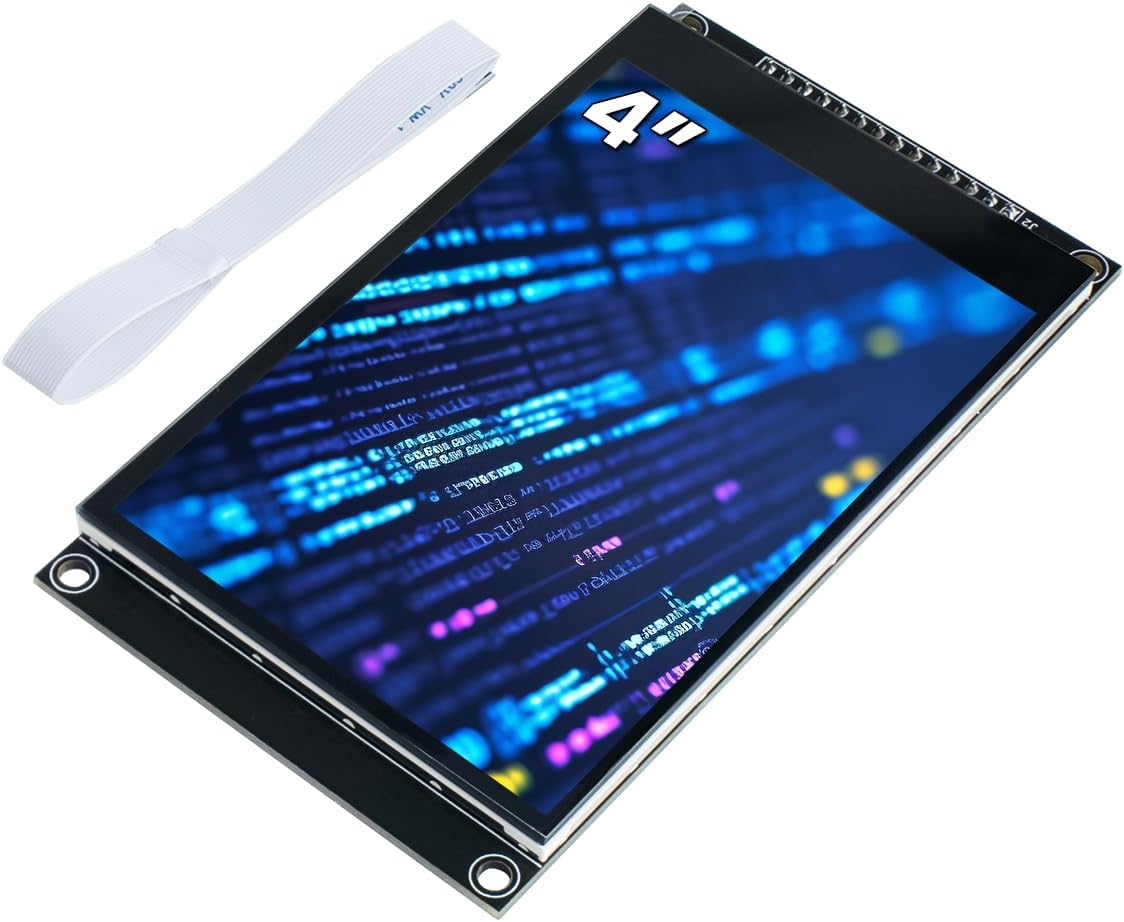
This large 4.0-inch screen provides a modern interface for advanced Arduino applications. Rated 3.9 stars it offers high resolution color and capacitive touch. The ST7796S driver ensures smooth updates via SPI.
We may earn a commission when you buy through this link, at no additional cost to you.
The capacitive touch makes navigation much easier than resistive options. It supports 5V and 3.3V logic levels thanks to onboard converters. A TF card slot is available for easy storage expansion.
While powerful it may require more complex wiring and configuration than simple text displays. The rating suggests some users find setup challenging. It is best for projects needing rich visuals.
This module is suited for advanced builders needing a dashboard display. The brightness and size are impressive for the price. We recommend it for robotics control panels.
Upgraded capacitive touch provides a more responsive and accurate user experience than older resistive types.
The 320×480 resolution allows for detailed graphics and clearer text on the 4-inch screen.
We may earn a commission when you buy through this link, at no additional cost to you.
This pack offers five OLED screens for versatile use across multiple projects. With a 4.6 rating it is praised for its contrast and brightness. The self-luminous pixels provide excellent readability without backlight.
We may earn a commission when you buy through this link, at no additional cost to you.
Each module uses the SSD1306 driver which is widely supported. You get a mix of blue and yellow displays for different aesthetic needs. Power consumption is very low making it ideal for battery use.
The small 0.96-inch size limits graphics to icons or text. Viewing angles are wide ensuring visibility from various positions. It is a robust choice for simple status indicators.
This product is perfect for bulk buyers or prototyping labs. The variety of colors allows for creative project design. We suggest it for wearable electronics or IoT nodes.
OLED technology ensures high contrast even in dark environments without needing a backlight power.
Receiving five units allows you to equip multiple projects or keep spares for future repairs.
We may earn a commission when you buy through this link, at no additional cost to you.
This mini 2-inch display offers high-quality color graphics for small projects. Rated 4.3 stars it features an IPS panel for wide viewing angles. The 240×320 resolution provides crisp text and simple graphics.
We may earn a commission when you buy through this link, at no additional cost to you.
The SPI interface allows for compact wiring making it easy to install. It supports both 3.3V and 5V logic levels for broad compatibility. This makes it suitable for handheld electronics or small gadgets.
The screen is small but delivers rich colors and bright backlight. It is an excellent choice for portable devices where space is limited. Setup requires SPI knowledge which may be a hurdle for beginners.
We recommend this for makers building handheld tools or toys. The color quality stands out in its size class. It is a solid option for visual feedback.
The IPS technology ensures colors look accurate from almost any viewing angle.
Its small 2-inch size fits into tight enclosures ideal for portable devices.
We may earn a commission when you buy through this link, at no additional cost to you.
AITRIP delivers a high-quality 2-inch TFT display with exceptional ratings. With a 4.7 star rating it is praised for its brightness and clarity. The IPS panel ensures vibrant colors for data visualization.
We may earn a commission when you buy through this link, at no additional cost to you.
It supports both 3.3V and 5V logic levels making it compatible with many boards. The ST7789V controller offers efficient performance. Pin labels are clearly marked for easy wiring during setup.
The two-pack offers value for building multiple units or prototypes. It is versatile enough for dashboards and handheld devices. The SPI interface keeps connections minimal for clean designs.
This module is excellent for visualizing sensor data clearly. Its compatibility makes it a safe choice for various boards. We suggest it for custom user interface projects.
Clear pin markings such as VCC and GND simplify the setup process significantly.
The 4-wire SPI interface reduces IO pins required saving space on your microcontroller.
We may earn a commission when you buy through this link, at no additional cost to you.
Choosing the right display depends on your project's complexity power needs and interface requirements. Consider resolution type and wiring carefully.
Select I2C for simplicity and few pins or SPI for faster data rates and graphics. Parallel interfaces are complex but offer speed.
Prioritize I2C for simple text or SPI for detailed visuals.
Character displays are limited to text while TFT panels support graphics and touch. Larger screens need more power.
Choose based on data complexity and enclosure size.
OLED screens are efficient for battery projects while backlight LCDs consume more power. Verify voltage needs.
Use low power displays for portable devices.
Ensure the display matches your microcontroller logic level such as 3.3V or 5V. Check library support.
Select modules with known driver libraries.
If interactivity is needed consider capacitive touch screens. Resistive touch requires pressure.
Prioritize touch for interactive dashboards.
IPS and OLED panels offer wide viewing angles compared to TN. Ensure readability from all sides.
Choose wide angle for public displays.
Adjustable backlight helps in bright environments. OLEDs do not need backlight.
Consider ambient lighting conditions.
Multi-packs offer value for prototyping. Single premium modules cost more but offer features.
Buy packs for future spare usage.
Connect the display securely to the microcontroller following the pinout diagram. Use jumper wires carefully to avoid shorts.
Install the appropriate library in your IDE to initialize the screen. Write code to set text size and contrast levels.
Handle the module gently to prevent damage to the fragile glass. Keep it dry and away from excessive heat.
Not necessarily as OLED displays do not require backlight. However standard LCDs need backlight for visibility in dark rooms. You can adjust this with a potentiometer.
I2C uses two wires and is slower while SPI uses more wires but is faster. I2C saves pins making it easier for small projects. SPI is better for detailed graphics.
Yes if they support different I2C addresses or SPI pins. You may need a multiplexer for I2C. Check unique addresses for bus devices.
Check wiring connections and power supply voltage. Ensure the contrast is set correctly with the potentiometer. Verify the library matches the driver chip.
Use library functions to set text size or cursor position. You can adjust font settings in code. Ensure memory allows for larger text.
OLED displays generally consume less power than LCDs. Self-luminous pixels reduce the need for backlight power. This is ideal for battery projects.
The Hosyond 1602 and ELEGOO OLED models offer top performance for different needs. Their reliability and clarity make them standout choices for makers today.
Consider resolution and interface when prioritizing your project requirements. Simplicity is often better for basic sensor readouts.
Always verify current availability and pricing before purchasing. Prices fluctuate frequently so check the product page for the latest deals.