This guide compares the top Arduino temperature sensors for accuracy and ease of use. Find the best DHT11, DS18B20, and SHT31 modules for your next project.
As an Amazon Associate we earn from qualifying purchases. We may earn a commission when you buy through links on this page, at no additional cost to you. Read our affiliate disclosure.As an Amazon Associate we earn from qualifying purchases.Purchases through our links may earn us a commission, at no extra cost to you. Read our affiliate disclosure.
Finding the right Arduino temperature sensor is crucial for reliable projects. A good sensor provides accurate readings across various environments. It should connect easily to your microcontroller without complex wiring.
We compared ten top-rated sensors based on precision, build quality, and ease of use. Our analysis covers digital modules, waterproof probes, and humidity-combined units. Each pick suits different needs from hobbyists to industrial users.
Every pick shows key specs and real-world performance details. Prices and availability change frequently, so verify current offers before buying. This guide helps you select the perfect sensor for your specific application.
Top 3 Picks for Best Arduino Temperature Sensor
Best Budget
HiLetgo 5pcs DHT11 Temperature Humidity Sensor Module Digital Temperature Humidity Sensor 3.3V-5V Humidity Measure Range 20%-95% Temperature Measure Range 0-50℃ Celsius with Wires
Top 10 Best Arduino Temperature Sensor in 2026 Compared
Compare all ten sensors side by side to find the best fit for your needs. This table highlights key specifications like range, accuracy, and interface types.
Teyleten Robot SHT31-D SHT31 Temperature Humidity Sensor Module 2.4V-5.5V I2C IIC for Arduino 3pcs
Range: -40 to 125C
Accuracy: ±0.3C
Interface: I2C
Supply: 2.4 to 5.5V
This module ranks as our top pick for its excellent accuracy and robust build. It offers a wide temperature range and fast communication suitable for demanding projects. The I2C interface simplifies wiring by reducing pin usage significantly.
Pros
High precision accuracy
Wide operating range
Fast I2C bus
Low power usage
Includes 3 units
Cons
Slightly higher cost
Requires I2C knowledge
We may earn a commission when you buy through this link, at no additional cost to you.
The SHT31 chip provides reliable readings even in humid conditions. Its wide voltage tolerance ensures compatibility with various Arduino boards and power sources. The included set of three units allows for multiple monitoring points.
While the cost is slightly higher than basic sensors, the precision justifies the expense. I2C wiring is slightly more complex than single-wire but saves pins. It is ideal for professional or detailed climate monitoring.
Choose this sensor for projects requiring high accuracy and multi-point monitoring. It excels in industrial or scientific applications where stability matters. The package offers great value for multiple reliable units.
Superior Accuracy
Accuracy stays within ±0.3°C for reliable data logging and control loops.
Wide Voltage Support
Operates from 2.4V to 5.5V ensuring compatibility with diverse power sources.
HiLetgo 5pcs DHT11 Temperature Humidity Sensor Module Digital Temperature Humidity Sensor 3.3V-5V Humidity Measure Range 20%-95% Temperature Measure Range 0-50℃ Celsius with Wires
Range: 0 to 50C
Accuracy: ±2C
Interface: Single Wire
Supply: 3.3 to 5V
This is an ideal starting point for beginners needing basic temperature and humidity readings. It comes with five units and all necessary wiring components for easy setup. The single-wire protocol makes integration straightforward for new users.
Pros
Very affordable price
Simple wiring setup
Includes wires and caps
5 units per pack
Beginner friendly
Cons
Limited range
Lower accuracy
We may earn a commission when you buy through this link, at no additional cost to you.
The DHT11 sensor offers decent accuracy for general hobby projects. It works well with common Arduino boards and requires minimal code. The included bypass capacitor ensures stable readings during operation.
Accuracy is limited to ±2°C and the range is narrow compared to premium options. It is not suited for extreme cold or heat. However, the low cost allows experimentation without financial risk.
Perfect for classrooms or simple indoor monitoring projects. It provides essential functionality at a fraction of the cost of advanced sensors. Five units let you build multiple projects simultaneously.
Plug and Play
Includes pull-up resistors and bypass capacitors for stable out of box use.
Single Wire Protocol
Reduces pin usage and simplifies wiring for microcontroller connections.
Gikfun 1M DS18B20 Waterproof Digital Temperature Sensor with Adapter Module for Arduino (Pack of 3 Sets) EK1183
Range: -55 to 125C
Accuracy: ±0.5C
Interface: 1-Wire
Waterproof: Yes
This premium kit includes waterproof probes ideal for industrial or outdoor environments. The stainless steel casing ensures durability against moisture and corrosion. It comes with adapter boards for easy connection to microcontrollers.
Pros
Stainless steel probe
Fully waterproof design
Long probe length
Wide temp range
Includes adapter board
Cons
Requires resistor
Slower read speed
We may earn a commission when you buy through this link, at no additional cost to you.
The DS18B20 chip provides excellent accuracy across a wide temperature range. It can measure from freezing to high heat with reliable precision. The 1-Wire bus allows multiple sensors to share one GPIO pin.
Wiring requires a pull-up resistor which is included but adds a step. Read speeds are slower than I2C sensors. These trade-offs are acceptable given the waterproofing and durability features.
Best for monitoring liquids, greenhouses, or harsh environments. The 1-meter cable offers flexibility for placement. Three sets allow comprehensive coverage of large areas.
Waterproof Construction
Stainless steel probe with sealant allows full submersion in water.
1-Wire Bus
Multiple sensors can connect to a single data pin easily.
2pcs AHT30 High Precision Digital Temperature and Humidity Sensor Measurement Module I2C IIC Communication AHT20 AHT21 AHT10 Upgraded Version for Arduino Humidity Temperature Sensor
Range: -40 to 85C
Accuracy: ±0.3C
Interface: I2C
Supply: 2.0 to 5.5V
This sensor offers high precision performance with a perfect user rating. It supports simultaneous access to multiple devices via the I2C bus. The module is compact and uses a 4-pin test line for quick setup.
Pros
High accuracy readings
Fast I2C communication
Low power usage
Simple 4-pin connection
Two units included
Cons
Shorter range than others
Requires I2C pins
We may earn a commission when you buy through this link, at no additional cost to you.
Accuracy is maintained at ±0.3°C making it suitable for calibration tasks. The wide voltage range allows flexible power options. It consumes low power which is ideal for battery powered projects.
The temperature range is limited to 85°C which may not suit high heat needs. It requires I2C pins which may be limited on some boards. These are minor issues for most indoor applications.
Choose this for indoor climate monitoring or precise data logging. It offers excellent value for two units. The fast read speed supports responsive control systems.
Fast Response
Stable and fast transmission speed enables real-time environmental tracking.
Multiple Device Support
Supports simultaneous online access to multiple I2C electronic devices.
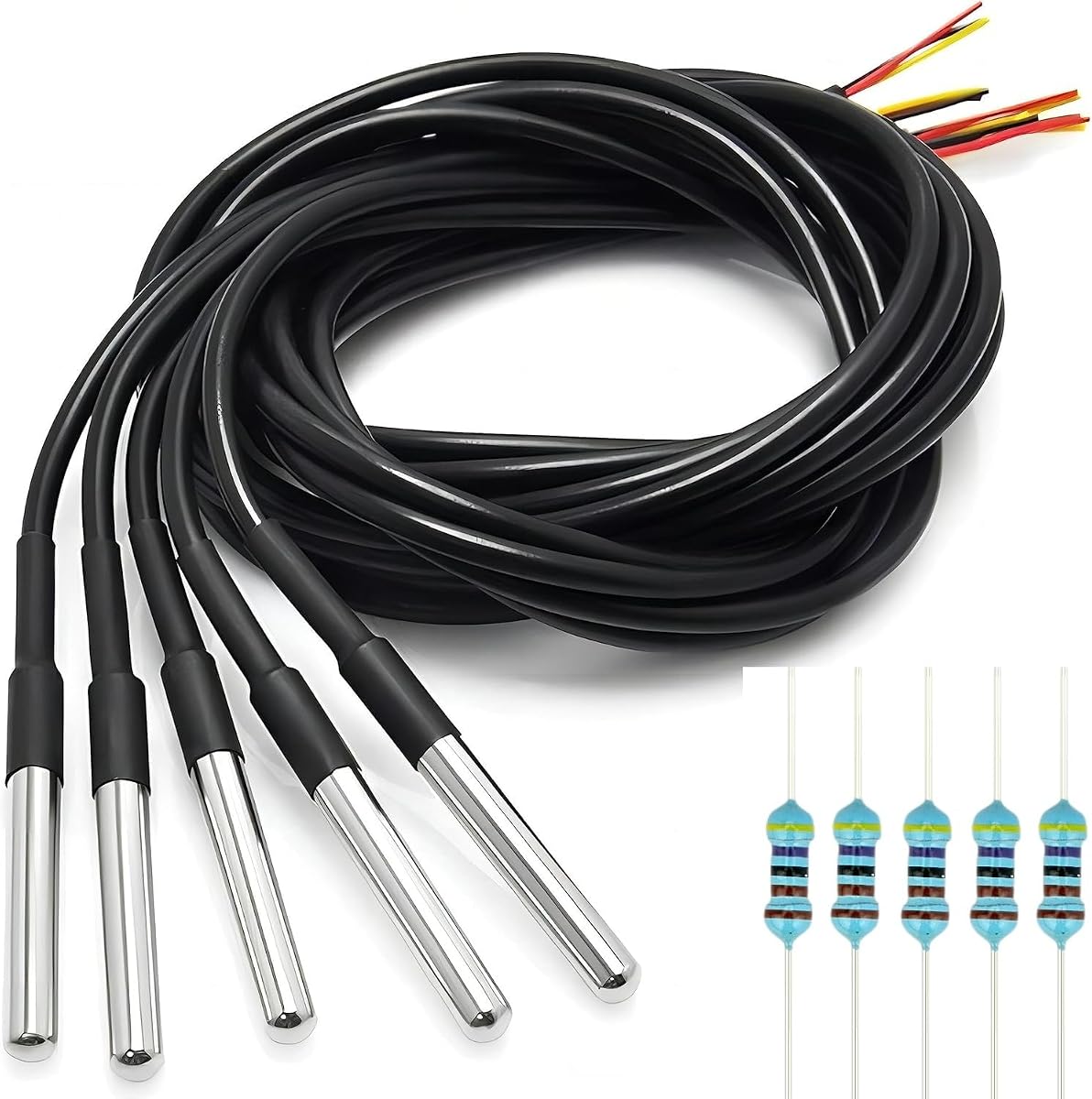
WWZMDiB 5 Pcs DS18B20 Temperature Sensor Probe High-Accuracy Waterproof Equipped with 5 Pcs 4.7K resistors for Arduino Raspberry Pi DIY
Range: -55 to 125C
Accuracy: ±0.5C
Interface: 1-Wire
Supply: 3 to 5.25V
This set provides five waterproof probes along with necessary resistors for wiring. It supports Arduino and Raspberry Pi platforms with simple connections. The waterproof design handles wet environments effectively.
Pros
Five units included
Resistors included
Waterproof probes
Wide voltage range
Great price value
Cons
Standard read speed
Cable protection minimal
We may earn a commission when you buy through this link, at no additional cost to you.
The DS18B20 chip ensures accurate readings across a wide range. It can be used for both indoor and outdoor monitoring. Five units allow monitoring multiple zones simultaneously.
The included resistors simplify assembly. Protection on the cable may be minimal. Overall value is excellent for DIY projects requiring multiple sensors.
Ideal for home aquariums or greenhouse setups. The five pack offers scalability. It is ready for use with minimal extra parts.
Ready to Use
Includes 4.7K resistors so you need fewer extra components.
Versatile Supply
Operates from 3V to 5.25V for flexible power options.
2pcs DHT11 Temperature Humidity Sensor Module Digital Temperature Humidity Sensor 3.3V-5V with Wires for Arduino Raspberry Pi 2 3 (2pcs DHT11)
Range: 0 to 50C
Accuracy: ±2C
Interface: Single Wire
Supply: 3.3 to 5V
This pack provides two DHT11 modules with included wires for immediate use. It features digital output which simplifies programming. The sensor uses a dedicated digital module for high reliability.
Pros
Two units included
Simple digital output
Long term stability
Easy integration
Beginner friendly
Cons
Basic accuracy
Limited range
We may earn a commission when you buy through this link, at no additional cost to you.
Accuracy is sufficient for general monitoring. It has proven long term stability. Simple wiring makes it easy to integrate into any project.
Accuracy is basic at ±2°C. The range is limited to 50°C. It is best suited for indoor use only.
Good for beginners starting with temperature projects. Two units allow testing redundancy. It is a solid baseline choice.
Long Term Stability
Uses digital modules to ensure excellent long term stability in readings.
Digital Output
Outputs digital signals directly for easier microcontroller reading.
DROK 2 Pack Waterproof DS18B20 Temperature Sensor Probes with 2 Pack Probe Adapter Boards, Female to Female Jumper Wires and 4.7K ohm Resistors for Arduino Raspberry Pi DIY
Range: -55 to 125C
Accuracy: ±0.5C
Interface: 1-Wire
Includes jumper wires
This complete kit includes wires and adapter boards for quick assembly. The stainless steel probe resists corrosion effectively. It comes highly rated for reliability and ease of use.
Pros
Includes jumper wires
Includes adapter boards
Waterproof steel probe
Low power operation
High customer rating
Cons
More components to assemble
Requires careful wiring
We may earn a commission when you buy through this link, at no additional cost to you.
The 1-Wire protocol simplifies wiring with internal pull-up resistors. Wide voltage operation ensures compatibility with various controllers. It offers low power consumption for battery projects.
More components can increase assembly complexity. Wiring must be done carefully. These are manageable steps for experienced users.
Best for DIY users wanting a full set. The jumper wires save time. It is highly reliable for harsh conditions.
Complete Kit
Includes adapter boards and jumper wires to save you time.
Flexible Voltage
Operates from 3.0V to 5.5V for broad compatibility.
Gikfun 5PCS 1M DS18B20 Temperature Sensor Waterproof Digital Thermal Probe Sensor for Arduino EK1083
Range: -55 to 125C
Accuracy: ±0.5C
Interface: 1-Wire
Length: 1 meter
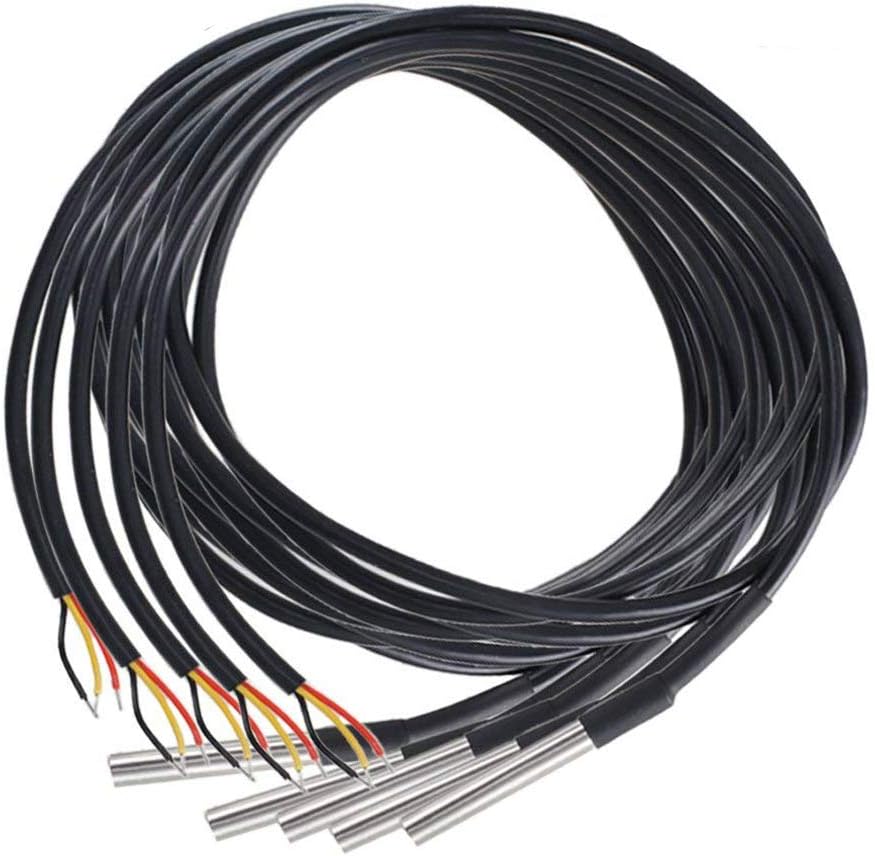
This pack provides five waterproof thermal probes with a 1-meter length. It uses the single-bus interface for easy wiring. The wide temperature range makes it suitable for diverse applications.
Pros
Five units included
Long probe length
Wide temperature range
Simple wiring
Affordable
Cons
Requires resistor
Slower read speed
We may earn a commission when you buy through this link, at no additional cost to you.
Accuracy is high at ±0.5°C. The probes are durable for wet environments. Five units allow extensive monitoring setups.
A resistor is recommended for testing ease. Read speed is not instant. These are acceptable trade-offs for durability.
Best for large area monitoring. Five units provide excellent value. The length ensures flexible placement options.
Long Probe
The 1 meter cable gives you flexible placement for sensors.
Wide Range
Measures from -55C to 125C for versatile environments.
HiLetgo 2pcs DHT22/AM2302 Digital Temperature and Humidity Sensor Module Temperature Humidity Monitor Sensor Replace SHT11 SHT15 for Arduino Electronic Practice DIY
Range: -40 to 80C
Accuracy: ±0.5C
Interface: Single Wire
Supply: 3.3 to 5V
This module replaces older SHT models with better performance. It offers a wider temperature range than standard DHT11. Accuracy is improved for both temperature and humidity measurement.
Pros
High accuracy humidity
Wider temp range
Fixing screw holes
Single-bus output
Replaces older models
Cons
Requires specific code
Slightly pricier
We may earn a commission when you buy through this link, at no additional cost to you.
Fixing screw holes make it easy to mount securely. Bidirectional serial data ensures reliable communication. Two units are included in the set.
Programming may require specific libraries. Price is higher than basic DHT11. Accuracy benefits justify the cost.
Ideal for precise environmental monitoring. It offers improved specs over competitors. Good for projects needing reliable humidity data.
Secure Mounting
Includes fixing screw holes to keep your sensor stable in place.
High Accuracy
Provides ±0.5C accuracy for precise temperature measurements.
HiLetgo 5pcs DS18B20 Temperature Sensor Temperature Probe Stainless Steel Package Waterproof 1M
Range: -55 to 125C
Accuracy: ±0.5C
Interface: 1-Wire
Supply: 3.0 to 5.5V
This pack offers five waterproof probes with stainless steel casing. It ensures durability for underwater use. The wide temperature range covers most industrial needs.
Pros
Stainless steel package
Five units included
Waterproof design
Wide range
Reliable performance
Cons
Requires resistor
Basic packaging
We may earn a commission when you buy through this link, at no additional cost to you.
Accuracy is solid for monitoring applications. Five units allow multi-zone setups. It is easy to integrate with minimal components.
Requires a resistor for testing. Packaging is basic. Overall performance is reliable and consistent.
Best for long term deployments. Five units ensure replacements. It provides solid value for water projects.
Durability
Stainless steel packaging protects your sensor from damage.
Multiple Units
Five probes in one pack ensure you have replacements available.
We may earn a commission when you buy through this link, at no additional cost to you.
Buying Guide – How to Choose the Best Arduino Temperature Sensor
Choosing the right sensor depends on your project requirements and environment. Consider accuracy range interface type and durability before purchasing.
Accuracy Requirements
High precision sensors like SHT31 offer ±0.3°C accuracy while basic units like DHT11 offer ±2°C. Determine how critical precise data is for your application.
Prioritize accuracy for scientific or industrial use.
Temperature Range
Most sensors work between -40°C to 85°C but DS18B20 units extend to 125°C. Check your environment limits to ensure the sensor survives.
Match the range to your specific operational needs.
Interface Type
I2C interfaces use two pins and support multiple devices. Single-wire or 1-Wire use one data pin and are simpler. Choose based on pin availability.
Use I2C for multi-sensor setups.
Environmental Protection
Waterproof probes are essential for outdoor or liquid monitoring. Stainless steel cases add durability. Standard modules are for indoor dry use only.
Select waterproof probes for harsh conditions.
Power Consumption
Some sensors draw more power which affects battery life. Low power units are critical for remote battery powered projects. Check voltage specs carefully.
Opt for low power for mobile units.
Ease of Wiring
Modules with pull-up resistors simplify connections. Some kits include wires and adapters. Others require soldering or extra components.
Look for kits with included accessories.
Number of Units
Packages often sell in sets of two or five. Buying in bulk saves money for multiple zones. Check pack sizes before purchasing.
Choose multi-packs for scalability.
Cost Efficiency
Prices vary significantly between basic and premium models. Weigh accuracy and durability against budget constraints. Best value comes from matching features to needs.
Balance cost with required features.
How to Use and Care for Your Arduino Temperature Sensor
Always connect voltage to VCC and ground to GND before wiring data lines. Ensure the Arduino is powered off to prevent shorts.
Install required libraries like OneWire or DHTlib to read data. Upload example sketches to test sensor function before main project coding.
Protect waterproof probes from physical damage and secure cables properly. Keep standard modules away from moisture for long term stability.
Frequently Asked Questions
Which Arduino temperature sensor is most accurate?
The SHT31 is most accurate with ±0.3°C precision. It supports I2C and covers a wide temperature range.
Can I use DS18B20 underwater?
Yes waterproof versions of DS18B20 are designed for underwater use. Ensure the probe casing is intact for full protection.
Do I need a resistor for DHT11?
Yes a pull-up resistor is required for stable operation. Most modules include this component already on the board.
How many sensors can connect to one Arduino?
I2C sensors support many units via address. 1-Wire sensors can connect multiple units on a single pin.
What is the best sensor for beginners?
DHT11 is best for beginners due to simplicity and low cost. It uses a single-wire protocol.
Why are readings fluctuating?
Fluctuations may result from power noise or poor connections. Check wiring stability and power supply quality first.
Can I read humidity with DS18B20?
No DS18B20 measures temperature only. Use DHT11 or SHT31 for combined humidity readings.
How do I calibrate the sensor?
Compare readings with a trusted thermometer. Adjust your code math or replace the sensor if errors persist.
Final Thoughts on Choosing the Best Arduino Temperature Sensor
We highlighted top picks like SHT31 for accuracy and DHT11 for budget. Each option suits specific project needs and environmental conditions.
Prioritize waterproofing and range for outdoor use. Select I2C for multi-sensor setups and single-wire for simplicity.
Always check current pricing before buying. Prices vary across vendors and availability changes regularly.
This guide compares the best Dometic electric coolers for camping and RVing including compressor and thermoelectric models for reliable cold storage anywhere.
This guide compares the top DVD players for projectors based on HDMI output, upscaling quality, region compatibility, and ease of setup for home theater