
Pyle Premium Direct Injection Audio Box
4.5Editor score
Affordable entry-level price
Hum eliminator included
Universal instrument connectivity
A bass direct box is essential for converting high-impedance instrument signals to low-impedance mic-level signals suitable for mixing consoles. It ensures clean transmission over long cables while eliminating hum and interference common in live sound environments.
We evaluated ten top-rated models based on build quality, transformer design, connectivity options, and user feedback. Our analysis covers passive and active units, highlighting performance differences for bassists, keyboardists, and audio engineers in various scenarios.
Each pick shows distinct advantages for specific use cases, from budget-friendly passive units to feature-rich active boxes. Prices and availability can change, so verify current details before purchasing to ensure you get the best value for your setup.
4.5Editor score

4.7Editor score
4.8Editor score
As an Amazon Associate we earn from qualifying purchases.
The following table provides a side-by-side comparison of all ten selected bass direct boxes, highlighting key specifications and unique features to help you quickly identify the model that best fits your recording or performance needs.




The Radial Pro DI is widely regarded as the gold standard for passive direct boxes, earning a solid 4.7 rating from users who value reliability and audio fidelity in professional settings.
We may earn a commission when you buy through this link, at no additional cost to you.
Its custom transformer ensures minimal signal loss and maximum clarity, while the rugged I-beam construction protects internal components from the physical demands of touring and frequent setup changes.
While it lacks extra features like pads or ground switches found on pricier models, its straightforward design eliminates points of failure, making it ideal for musicians who need consistent performance without complexity.
Musicians and engineers seeking a dependable workhorse for bass and keyboard inputs will find this unit worth the investment for its longevity and clean signal transmission in any environment.
The steel I-beam chassis resists impact and vibration, ensuring the unit survives the rigors of road travel and daily stage use without compromising performance.
The custom transformer preserves the natural tone of your bass or instrument, delivering a clear balanced output that integrates seamlessly with mixing consoles.
We may earn a commission when you buy through this link, at no additional cost to you.
The Pyle Premium Direct Injection Audio Box offers an accessible entry point for musicians needing basic DI functionality without breaking the budget, rated 4.5 for its value proposition.
We may earn a commission when you buy through this link, at no additional cost to you.
It features a built-in hum eliminator and input attenuator, allowing users to clean up noisy signals and prevent overload when connecting basses or keyboards to PA systems.
While it uses lighter materials compared to professional units and may not withstand heavy touring, it performs adequately for occasional gigs, rehearsals, and home recording setups where cost is a priority.
Beginners and casual performers looking for a simple tool to connect unbalanced instruments to balanced inputs will appreciate its straightforward operation and compact footprint.
The built-in hum eliminator actively cancels buzz and interference from ground loops, ensuring cleaner audio output during live performances or recordings.
Connecting your bass or guitar is as easy as plugging into the 1/4 inch connector, making it user-friendly for musicians of all skill levels.
We may earn a commission when you buy through this link, at no additional cost to you.
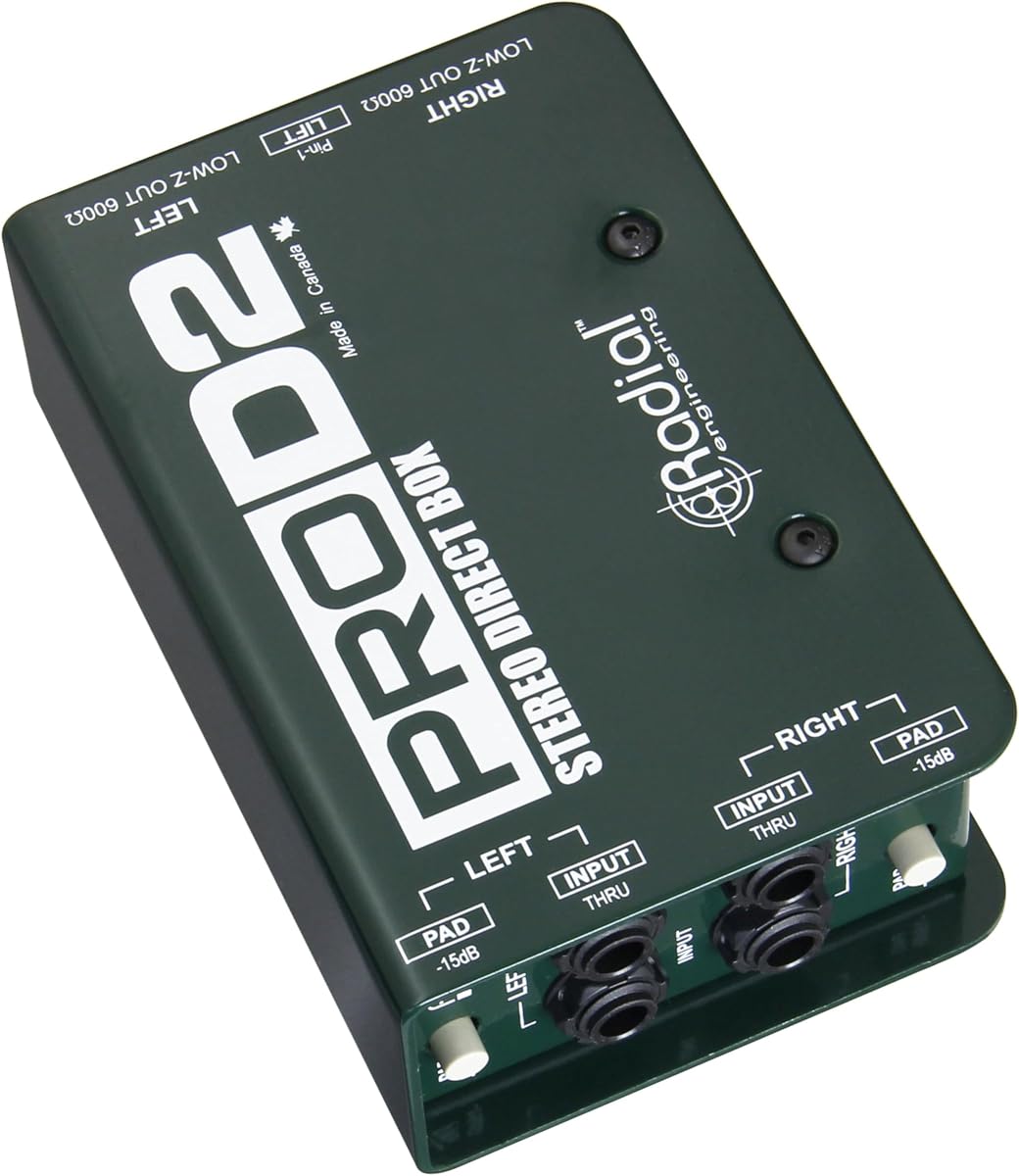
The Radial ProD2 earns a 4.8 rating for its dual-channel design that supports stereo setups without compromising signal integrity, making it a top choice for keyboardists and advanced rigs.
We may earn a commission when you buy through this link, at no additional cost to you.
It includes isolation transformers on both channels to prevent ground loops, along with a lift switch and 15dB pad to manage signal levels and noise in challenging acoustic environments.
Its all-steel construction ensures it can handle the demands of professional touring, though its higher cost and size might be unnecessary for simple single-instrument applications.
Musicians requiring stereo outputs for synths or dual instruments will find this box delivers pristine sound quality and robust build quality that justifies the investment.
Both channels maintain independent signal paths, preserving stereo width and detail for keyboards, synths, or dual-bass setups without mono summing.
The 15dB pad allows you to reduce hot signals before they overload the mixer, while the lift switch eliminates ground loop noise effectively.
We may earn a commission when you buy through this link, at no additional cost to you.
The Whirlwind IMP 2 is praised for offering professional sound quality at an economical price, rated 4.8 for balancing performance and affordability in a compact package.
We may earn a commission when you buy through this link, at no additional cost to you.
Its TRHL transformer is riveted rather than glued to the chassis, ensuring a secure connection that reduces microphonics and improves overall durability over time.
While it lacks some extra features like a ground lift switch, its straightforward design minimizes potential failure points and delivers clean, balanced signals for most standard applications.
Musicians looking for a reliable, no-fuss direct box that sounds great and fits easily on a pedalboard or in a gig bag will find it an excellent choice.
The riveted TRHL transformer ensures a more stable connection than glued alternatives, reducing noise and maintaining consistent performance over years of use.
Its small footprint makes it easy to carry and mount on a pedalboard, ideal for players with limited space in their setup.
We may earn a commission when you buy through this link, at no additional cost to you.
The PYLE-PRO PDC22 stands out in its price range by offering dual input channels alongside standard features like a hum eliminator and steel chassis, rated 4.4 for utility and durability.
We may earn a commission when you buy through this link, at no additional cost to you.
Its all-steel housing provides a sturdy frame that protects components, while the dual-channel design allows for connecting two instruments simultaneously or splitting a signal for monitoring.
While it may not match the audio fidelity of higher-end models, it serves well for home studios, practice spaces, and smaller gigs where cost and flexibility are more important than audiophile-grade performance.
Players needing to run two instruments or a guitar and vocal mic through one unit will appreciate its simple, effective design that keeps things organized and functional.
Having two channels allows you to connect multiple instruments or split a signal without needing extra hardware, streamlining your setup process.
The steel chassis shields internal components from impacts and daily wear, extending the unit's life even with frequent handling.
We may earn a commission when you buy through this link, at no additional cost to you.
The Bolanle DB2 offers a budget-friendly solution for stereo DI needs, earning a 4.6 rating for its feature set that includes ground lift, signal attenuation, and dual XLR outputs.
We may earn a commission when you buy through this link, at no additional cost to you.
Its passive design avoids the need for external power, while the ground lift switch and signal attenuation settings help manage noise and levels across a range of instruments and environments.
Though it lacks the premium build quality of top-tier units, its scratch-resistant casing and road-ready design make it suitable for touring musicians on a budget who need stereo separation.
Keyboardists and synthesizer players looking for an affordable stereo output option will find it delivers clear, accurate sound without the complexity of active power requirements.
The attenuation switch with multiple settings prevents signal overload by allowing you to lower input levels as needed for different instruments.
The scratch-resistant finish protects the unit during transport and setup, keeping it looking professional even after extensive use.
We may earn a commission when you buy through this link, at no additional cost to you.
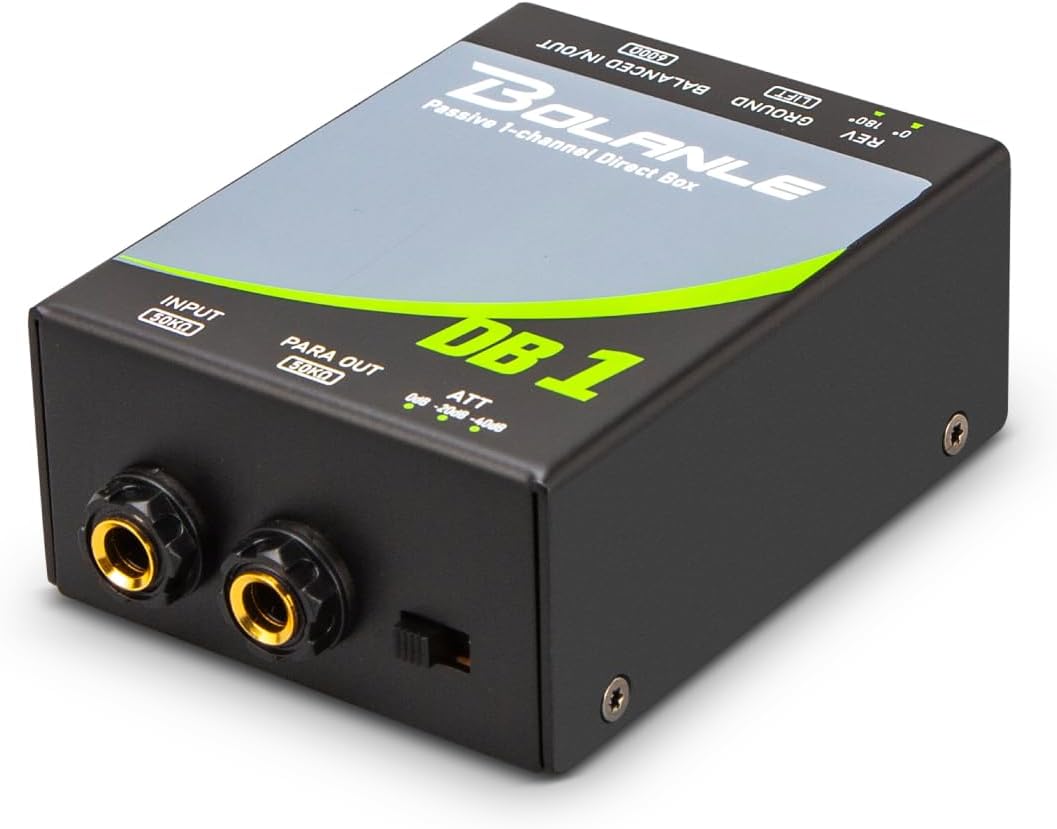
The Bolanle DB1 provides a straightforward passive DI solution with a 4.5 rating, focusing on clean signal conversion and reliability without requiring external power sources.
We may earn a commission when you buy through this link, at no additional cost to you.
It features a built-in feedback eliminator and parallel output, giving you the flexibility to send signals to both mixers and amps simultaneously without sacrificing quality.
While it lacks the advanced features of more expensive models, its robust construction and simple controls make it a practical choice for guitarists and bassists needing a dependable mono box.
Musicians who prioritize ease of use and portability will find this unit meets their needs for clean transmission in both live and studio contexts.
As a fully passive box, it requires no batteries or phantom power, ensuring you can play anywhere without worrying about power availability.
The parallel output allows you to run your instrument to an amp while sending a clean signal to the mixer for monitoring or recording.
We may earn a commission when you buy through this link, at no additional cost to you.
The Bolanle J22 earns a 4.6 rating for its unique triple power option system, ensuring you never run out of juice during a performance while delivering clean active stereo conversion.
We may earn a commission when you buy through this link, at no additional cost to you.
Its dual XLR outputs maintain full stereo separation, making it ideal for keyboardists and synths, while the ground lift switch effectively breaks interference from noisy power systems.
Although active units require power, the inclusion of battery, USB, and phantom options means you can adapt to any venue setup without sacrificing signal quality or convenience.
Musicians playing in varied environments who need reliable stereo performance will find this box offers the flexibility and power efficiency required for modern stage setups.
With support for phantom power, 9V batteries, and USB, the J22 can run in any situation, eliminating the risk of a dead battery mid-set.
Dual XLR outputs preserve the stereo image of your keyboard or synth, keeping left and right channels separate for a fuller sound.
We may earn a commission when you buy through this link, at no additional cost to you.
The Radial Pro48 is a high-resolution active box rated 4.7 for its ability to deliver detailed sound from passive instruments when paired with phantom-powered mixers.
We may earn a commission when you buy through this link, at no additional cost to you.
Its compact size fits easily on small pedalboards, and the built-in 15dB pad helps manage hot signals, making it versatile for basses and guitars with high output.
While it depends on phantom power and lacks stereo outputs, its professional engineering ensures minimal noise and maximum clarity in any recording or live sound scenario.
Musicians needing a small, powerful active DI that integrates seamlessly with studio and stage gear will find it delivers top-tier performance in a portable package.
Using phantom power allows the internal circuit to boost weak signals, providing better fidelity for passive pickups without needing batteries.
The built-in 15dB pad protects against input overload from active instruments, ensuring a clean signal path even with high-output pickups.
We may earn a commission when you buy through this link, at no additional cost to you.
The Pyle PDC21 rounds out the list with a 4.5 rating, offering a steel chassis and hum eliminator for a budget-conscious user seeking basic professional connectivity features.
We may earn a commission when you buy through this link, at no additional cost to you.
Its heavy-duty construction promises longevity, and the ground lift adapter ensures clean audio transmission from basses, keyboards, or effects processors to mixing consoles.
While it lacks advanced options like stereo outputs or multiple power sources, it serves well as a reliable go-to box for rehearsals and smaller venues where simplicity is key.
Musicians who need a straightforward, durable DI box without extra complexity will find this model delivers clean audio and lasting performance at an accessible price.
The steel chassis provides a strong foundation that withstands drops and bumps better than plastic alternatives, ensuring reliable performance over time.
By effectively eliminating hum and buzz, this unit ensures your instrument tone remains clear and unaffected by environmental noise during performances.
We may earn a commission when you buy through this link, at no additional cost to you.
Selecting the right bass direct box depends on your specific audio needs, equipment setup, and performance environment.
Passive boxes use transformers to convert signals without needing external power, making them reliable and simple. Active boxes require phantom power, batteries, or USB to boost weak signals and often provide better frequency response for high-impedance sources.
Choose passive for simplicity and power independence; choose active if you need enhanced signal integrity from high-impedance instruments.
Single-channel boxes suit bassists needing one output, while dual-channel units allow for stereo outputs or simultaneous dual-instrument connectivity. Stereo is essential for keyboards and synths to preserve width.
Assess whether your setup requires mono or stereo outputs to determine the right channel configuration for your workflow.
Touring musicians require rugged chassis materials like steel and I-beams to survive frequent transport and impact. Home users may prioritize compact sizes and lighter materials to save space.
Look for robust construction if you tour regularly to ensure your equipment remains reliable over years of use.
Transformers define the core sound quality and isolation capability of a box. Custom or riveted transformers typically offer better fidelity and fewer microphonics than standard glued units.
Prioritize units with high-quality transformers to ensure clean signal conversion and minimal noise interference.
Features like ground lift switches, pads, and attenuation controls help manage signal levels and eliminate hum. Basic boxes may lack these controls, limiting flexibility.
Choose a model with essential controls like ground lift and pad if you often face noise issues or signal overload.
Passive units need no power, while active models may use batteries, phantom power, or USB. Consider your venue's available power options and your convenience needs.
Ensure your chosen box matches your available power sources to avoid performance interruptions during shows.
Prices vary widely from budget-friendly options to high-end professional units. Balance your financial constraints with the features and durability you require for long-term use.
Invest in higher-quality units if you rely on them daily or professionally to save on replacements and repairs over time.
Most units feature 1/4 inch instrument inputs and XLR outputs. Some also offer parallel outputs or TRS connectors for additional routing flexibility.
Check that the box supports the connectors on your instruments and mixer to simplify your cabling setup.
Connect your instrument to the 1/4 inch input jack and run an XLR cable from the output to your mixing console or interface. Use a ground lift switch if you hear buzzing noises caused by ground loops.
For active models, ensure phantom power is enabled on your mixer or insert a fresh battery. Avoid overloading inputs by engaging the pad switch if your instrument has a high output level.
Store your direct box in a padded gig bag or case when not in use to protect against physical damage. Keep the unit dry and away from extreme temperatures to maintain component integrity.
A bass direct box converts high-impedance unbalanced instrument signals to low-impedance balanced microphone-level signals. This allows your bass to connect directly to a mixing console, ensuring clean transmission over long cables and eliminating hum.
Passive boxes are simpler and do not need power, making them ideal for most basses. Active boxes provide better signal clarity for high-impedance or vintage instruments but require phantom power or batteries to function.
A ground lift switch is essential for eliminating hum and noise caused by ground loops between your instrument and mixer. Most professional boxes include this feature, and it is recommended for live performances.
Yes, many direct boxes support keyboard outputs, but stereo models are preferable to preserve the width of your sound. Check that the unit supports the signal levels of your synthesizers or digital pianos.
Use a 1/4 inch instrument cable to connect your bass to the input and an XLR cable from the output to your mixer. Avoid long unbalanced cables to prevent signal degradation and noise interference.
Active boxes can be powered via phantom power from your mixer, a 9V battery, or USB depending on the model. Ensure your power source matches the unit's requirements to avoid damage or failure.
This may happen if the transformer impedance mismatch or a poor-quality box is rolling off low frequencies. Upgrade to a unit with a custom transformer to preserve your tone.
It is highly recommended for home recording to ensure clean input into your audio interface. It eliminates noise and matches your bass impedance properly for accurate recording.
We have reviewed ten top-rated direct boxes ranging from affordable passive models to high-end active units designed for professional stereo needs.
Prioritize build quality and transformer performance if you tour frequently, but choose simplicity and cost-effectiveness for practice and home use.
Always verify current pricing and availability online before purchasing to ensure you secure the best value for your specific musical requirements.